
March 10, 2026
ThreadX 2026: Why ‘Complexity’ Will Define the Economy in 2026
Economist Alex Chausovsky said that, while 2025 was all about uncertainty, 2026 is about understanding complexities in the economy and pursuing worthwhile strategies.

Key Takeaways
• During a session at ThreadX 2026 last week, economist Alex Chausovsky said the defining economic theme for 2026 is “complexity,” as persistent volatility, tariffs and geopolitical dynamics continue shaping business conditions.
• Despite global tensions and slower growth, the U.S. remains the world’s dominant economy, with steady but modest growth expected in the equipment and apparel markets.
• Apparel companies should prioritize premium products targeting higher-income consumers, since younger and lower-income groups are facing financial pressure and reduced spending power.
The word for 2025 was “uncertainty.”
“We heard it all the time,” said economist Alex Chausovsky during a session at the ThreadX conference, held last week in Sundance, UT. “People didn’t know what was going to happen. President Trump had just started his second term in office. What was going to happen with taxes? What was going to happen with trade? How were we going to engage with our partners and our adversaries? No one really knew what to expect.”
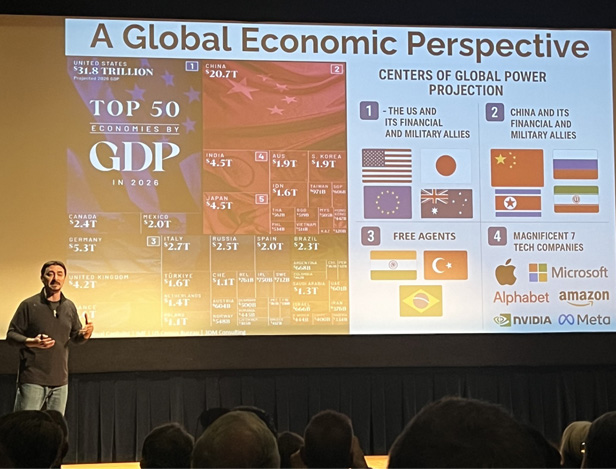
In his presentation, economist Alex Chausovsky presented data backing up his claim that the U.S. would remain the global economic driver despite fear of other countries’ growing influence.
A lot has happened since then. Some issues have been resolved, others have not. In many ways, the only constant is change and the only consistency is inconsistency.
Chausovsky said that, a year into this new normal, the word for 2026 is “complexity.”
“It’s the recognition that the volatility, the uncertainty and all of the constant change are not going anywhere,” he said. “As a business leader, as a decision-maker, as someone your people look up to, you’ve got to embrace that complexity and exude confidence.”
The Outlook for Print & Apparel
At ThreadX, Chausovsky provided updates from his economics presentation last year, where uncertainty was the theme. While he made no false claims that all was perfectly well with the economy and the average consumer’s buying power, he did stress that it isn’t all doom and gloom.
“The equipment market, which I know many of you are part of, is actually going to see a bit of a tick up relative to what we’ve seen in 2022, 2024 and 2025 as well,” he said. “And on the clothing side, on the end-user and consumer side, we’re going to have slow but stable growth. It’s not going to be anything to celebrate or write home about, but it is going to be positive.”
Before focusing on the audience’s areas of expertise and business, Chausovsky zoomed out a bit to look at the current state of the global economy one year into Trump’s second term. His main takeaway was that despite what some sources might say about the U.S.’s position on the global stage weakening, or other economies like China threatening to usurp its position as the world’s primary economic driver, the U.S. is still very much in the top spot.
“One of the narratives President Trump goes to – and one that I vehemently disagree with – is that the United States is somehow losing, that we’re giving up our position, that we’re being overtaken by our adversaries, that we’re somehow being taken advantage of,” he said. “That’s not true. And the data doesn’t support it either.”
He pointed to a chart showing the total GDP of major economic players across the world.
“The U.S. is at $31.8 trillion, by far the largest economy in the world, the most dominant,” he said. “From a business perspective, think of this as the market-share leader. To the right of that is China at $20.7 trillion. So, despite multiple decades of double-digit growth, they are still nowhere near the size of our economy. And with their growth slowing – they grew about 4.5% last year while we grew about 2.5% in 2025 – they’re never going to catch up in terms of total economic footprint and global dominance.”
His idea of economic complexity comes into play here as he explains that it’s not simply foreign governments complicating the current state of things, but also the presence of enormous and powerful technology corporations, such as Apple, Microsoft and Alphabet.
“These companies are supporting campaigns financially, influencing votes and throwing their weight behind different political parties,” he said. “So, you can see, it’s a very convoluted world out there, and things will continue to remain volatile, which is why I led with this idea that complexity isn’t going anywhere. You’ve got to be prepared.”
One thing he said that we can be prepared for is the continuation of tariffs – they were the main source of uncertainty last year, and now they’re the source of complexity, as it’s clear that they’re here to stay in some form.
“We are not going to get rid of tariffs,” he said. “If you look at tariff history, they always get normalized, assimilated and become the new pricing baseline.”
How To Be Prepared
Chausovsky stressed that you don’t have to be an expert on global economics and supply chain logistics or have any sort of deep understanding of geopolitics and forecasting. You should, however, surround yourself with people who do know these things.
“You have to be open to leveraging other people’s expertise when it benefits you,” he said. “That means building a network – an alliance – of people who know a lot about different things that you can tap when you have questions about specific subjects.”
Chausovsky says that the U.S. government was certainly prepared for the possibility, perhaps probability, that the Supreme Court would rule Trump’s initial sweeping tariffs unconstitutional.
“They saw the writing on the wall,” he said. “They were kind of hoping maybe they’d get lucky, but the pivot has been very, very clear.”
Chausovsky said that now the focus will be on future trade negotiations and opportunities for spotting “unfair practices” in trade, specifically for the equipment side of things.
“We import a lot of machinery from abroad, so they’re looking at each one of those countries and saying, ‘Is the government subsidizing that industry? Are there unfair practices? Does their labor system meet our expectations?’” he said. “As a result, we are going to get new equipment-specific tariffs in 2026.”
He added that these tariffs would not likely go away in the chance of a Democratic party presidential win in 2028.
“We certainly saw the Biden administration not only not remove President Trump’s first-term tariffs,” he said. “They actually amplified them.”
Opportunities for Sales in Apparel
Younger generations are struggling financially. Student loan delinquencies are high, and younger generations’ buying power is lower than that of their elders. Rising costs of housing, insurance, utilities and food, coupled with a difficult job market, has made it so younger buyers simply don’t have as much expendable income as other groups.
This means that companies marketing products to younger generations should perhaps adjust their strategy.
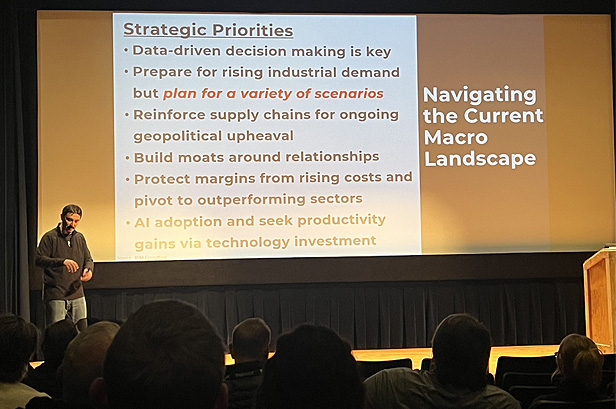
Chausovsky’s presentation detailed how professionals in the printed apparel and promotional products markets could appeal to the right customers for continued growth, such as marketing high-quality and luxury goods to more wealthy buyers with more purchasing power.
“If all of your products are targeted at that younger demographic, you’re vulnerable right now,” Chausovsky said. “Those customers are the ones feeling the squeeze the most. They’re the ones most likely to pull back on spending because they need to pay their bills first.”
He joked that the answer might be to create a “geriatric line” of products aimed at those over 40.
“But the point stands,” he said. “Think creatively. Recognize these patterns and adapt your product mix accordingly, because the younger generations are clearly feeling the squeeze the most.”
He recommended marketing instead toward an economic demographic that’s buying consumer goods right now, and want the products they buy to reflect their perceived status.
“When it comes to consumption today, growth is increasingly driven by higher-income households,” he said. “Meanwhile, the middle class and the bottom 40% are barely keeping up with inflation. They’re not really growing their spending, they’re just maintaining.”
If you want growth in your business, whether it’s apparel or any other consumer good or service, Chausovsky recommends that you ask yourself the following questions:
- Do you have products targeted at high-income customers?
- Do you offer a premium version of your product, or something that clearly appeals to affluent customers?
“Because that group is still spending,” he said. “Right now, I would say value products targeted at the general population will probably continue growing at low single digits. But the real opportunity lies in premium products that appeal to the top 20% of income earners – higher-end styles, premium offerings and higher-quality goods. That’s where the strongest spending is happening right now.”